Political
Governments push local manufacturing through policies like the US CHIPS Act and India’s PLI scheme, while trade wars disrupt global supply chains. Stricter labor laws and safety regulations raise compliance costs.
Industries
Manufacturing is the backbone of global economic growth, enabling mass production of goods from automobiles to electronics. The sector faces labor shortages, raw material price volatility and an urgent need for digital transformation, while Industry 4.0 technologies such as IoT-enabled smart factories, robotics and additive manufacturing are revolutionizing production.
To stay ahead, manufacturers must prioritize supply chain resilience, upskill workforces for advanced automation, pair technology investments with end-to-end strategic execution, digitize supplier risk management and tie sustainability metrics to executive incentives, which can unlock 15%+ productivity gains. They should also adopt circular economy principles to reduce waste and carbon footprints.

A PESTEL analysis helps understand the macro-environmental factors affecting the manufacturing sector:
Governments push local manufacturing through policies like the US CHIPS Act and India’s PLI scheme, while trade wars disrupt global supply chains. Stricter labor laws and safety regulations raise compliance costs.
Rising material costs (metals up 30% since 2020), energy volatility and interest rate hikes squeeze margins. Supply chain disruptions add 15–20% to logistics expenses, though reshoring creates new opportunities.
Skilled labor shortages leave 2M+ US factory jobs unfilled. Younger workers demand flexible jobs, forcing automation investment, and consumers prefer sustainable, locally-made products.
Industry 4.0 (IoT, AI, robotics) boosts productivity 25–30% for adopters. Digital twins cut prototyping costs by 40%, and 3D printing enables mass customization, while cybersecurity risks grow with connectivity.
Net-zero mandates require costly retrofits. Circular economy models reduce waste 15–20% but need new processes, and carbon taxes could add 5–8% to production costs by 2025.
Product liability suits (especially in auto and medical devices), IP protection challenges and evolving data privacy laws (like GDPR) create compliance burdens and litigation risk.

Smart factories use AI-powered predictive maintenance (reducing downtime by 30%) and digital twins (cutting prototyping costs by 40%). Over 60% of manufacturers will adopt IoT-enabled equipment by 2025 (McKinsey).
Geopolitical risks and supply chain disruptions drive 35% of US/EU firms to relocate production closer to home. Mexico and Eastern Europe emerge as key nearshoring hubs (BCG).
Strict ESG rules push circular production (20% waste reduction) and hydrogen-powered plants. Carbon accounting tools are now mandatory for 70% of large manufacturers (Deloitte).
Skills gaps leave 2.1M jobs unfilled (NAM). Companies respond with AR training (boosting productivity 25%) and cobots, collaborative robots working alongside humans.
Generative AI optimizes inventory (reducing excess stock by 15%) while blockchain enhances supplier transparency. Over 50% of manufacturers will use AI for demand forecasting by 2025 (Gartner).
3D printing and modular designs enable batch-of-one production at scale. Automotive and medical device leaders report 20% higher margins from personalized products (PwC).
With 67% of manufacturers hit by cyberattacks in 2023 (IBM), investment in zero-trust architectures and OT security is surging.
Volatile energy prices drive microgrid adoption (30% of German manufacturers now use onsite renewables) and energy-as-a-service models.


A Balanced Scorecard translates manufacturing strategy into goals across four perspectives: Financial, Customer, Internal Processes, and Learning & Growth. It boosts profitability, strengthens supplier relationships, optimizes production efficiency and drives innovation.
fruiStrategy helps manufacturers build industry-specific scorecards for critical challenges, from smart factory implementation and supply chain digitization to ESG compliance and workforce upskilling, delivering measurable results and sustainable growth.
Initiatives are strategic projects that bridge high-level objectives (like those in your Balanced Scorecard) and tangible outcomes, whether cutting production costs, improving quality or achieving net-zero targets.
For manufacturers, initiatives might include:
Each initiative is tied to KPIs (e.g., energy cost per unit, defect rate reduction or training completion rates) to track ROI.
fruiStrategy helps manufacturers execute initiatives with precision, from planning and budgeting to risk management and performance monitoring, with real-time visibility so investments in automation, sustainability and resilience deliver maximum impact.

Geopolitical tensions and material shortages delay production, and natural disasters further strain logistics networks.
Fluctuating fuel costs and carbon taxes unpredictably raise production expenses, hitting energy-intensive sectors hardest.
Connected factories face rising ransomware attacks targeting IoT systems, and data theft disrupts operations.
An aging workforce and tech skill gaps leave 2.1M US manufacturing jobs unfilled, and training lags behind Industry 4.0 needs.
Evolving ESG and safety compliance (e.g., EU CSRD) increases reporting burdens, and non-compliance risks fines up to 4% of revenue.
Metal and plastic prices swing 20–40% annually due to trade wars, making just-in-time models costlier.
Legacy systems struggle to integrate AI and automation, and late adopters face 15–20% productivity gaps.
ESG failures (pollution, labor issues) trigger boycotts, and social media amplifies scandals rapidly.
Unplanned downtime costs $260K/hour (Deloitte), and aging machinery raises breakdown risk.
The EV transition and deglobalization disrupt traditional product lines, and slow adapters lose contracts.

Strategic analysis tools and the BSC methodology help manufacturers align operational goals, track performance and drive long-term competitiveness. Set clear objectives, manage initiatives with defined ownership and budgets, and monitor progress through automated reporting.
Link objectives to efficiency gains, cost reduction and quality improvements, for continuous operational excellence.
Align CAPEX/OPEX with Industry 4.0 investments (IoT, AI, robotics).
Optimize procurement, inventory and logistics with real-time analytics.
Track carbon footprint, energy efficiency and regulatory adherence (e.g., CSRD, REACH).
Proactively address disruptions like material shortages or cyber threats.
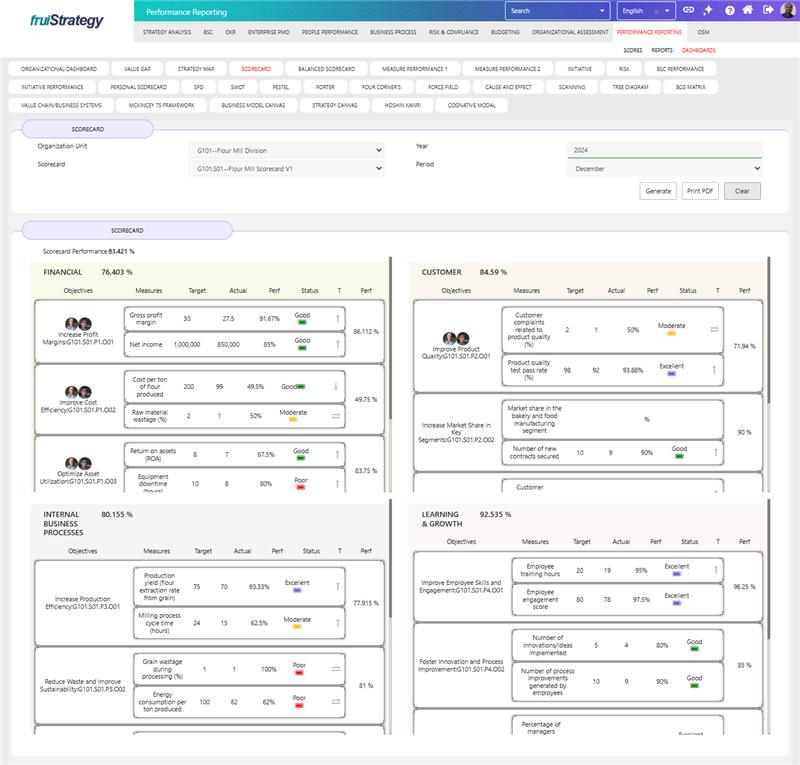
With real-time dashboards, 360-degree performance reviews and AI-powered insights, fruiStrategy helps manufacturers boost profitability, ensure agility and future-proof operations in a dynamic market.