Political
Trade policies, import/export regulations and food safety norms shape market access.
Industries
The FMCG industry delivers everyday essentials, from food to personal care, to billions of consumers worldwide. Inflationary pressures, shifting consumer preferences toward sustainability and the explosive growth of e-commerce are disrupting traditional retail models, so brands must balance cost efficiency with eco-friendly packaging, hyper-personalization and agile logistics to meet demand for convenience and ethical consumption.
Success hinges on using AI for demand forecasting and embracing direct-to-consumer (DTC) channels to compete with digital-native brands. Victory goes to players who replace static plans with adaptive, data-led strategies: real-time pricing algorithms tied to commodity indices, automated trade promotion ROI tracking and R&D pipelines aligned with zero-waste KPIs can turn omnichannel complexity into a 20% revenue growth engine. The winners will operationalize agility, turning every challenge into a customer-centric competitive edge.

A PESTEL analysis of the macro-environmental factors affecting the FMCG sector:
Trade policies, import/export regulations and food safety norms shape market access.
Disposable income, inflation and supply chain costs influence product pricing and demand.
Changing consumer preferences, health awareness and lifestyle shifts affect product development.
Automation, e-commerce platforms and AI-powered supply chains enhance efficiency.
Sustainability and waste reduction pressures drive eco-friendly packaging and sourcing.
Consumer protection laws, advertising regulations and labeling standards must be followed.

Brands are embracing biodegradable, reusable and recyclable packaging to reduce environmental footprint, and circular economy models and sustainable sourcing influence product design and innovation.
With rising digital consumption, companies are scaling DTC models, personalized online experiences and last-mile delivery through tech-enabled platforms.
Demand for healthier, organic and immunity-boosting products is shaping product lines, with investment in clean labels, functional foods and plant-based alternatives.
Players are improving supply chain visibility, AI-driven demand forecasting and multi-sourcing to handle disruptions and fluctuating consumer behavior.
Advanced analytics, CRM and AI deliver hyper-personalized product recommendations, loyalty programs and customer engagement campaigns in real time.


A Balanced Scorecard helps FMCG organizations align vision with action across Financial growth, Customer engagement, Internal efficiencies, and Learning & Innovation, giving a roadmap for scaling product innovation, brand loyalty and market responsiveness.
fruiStrategy helps FMCG companies build a focused Balanced Scorecard for dynamic markets, balancing high-volume production, digital marketing, supply chain agility and sustainable practices to stay ahead of consumer trends and competition.
FMCG initiatives are projects that address gaps in customer experience, market penetration or operational efficiency, helping companies adapt quickly to evolving market conditions.
Typical initiatives include:
KPIs such as market share increase, fewer stockouts or better net promoter score (NPS) show how effective each initiative is.
fruiStrategy helps FMCG firms map, manage and monitor initiatives from idea incubation to execution, with budgeting by strategy type, real-time reporting and collaborative reviews for rapid, measurable business impact.

Dependence on raw materials from different geographies exposes firms to delays and cost spikes.
Rapidly changing tastes and health trends can make products obsolete.
Scandals, recalls or poor customer service can damage brand equity.
Changes in labeling, health safety or advertising laws can affect compliance.
Failing to adapt to digital selling trends may reduce market reach.
Supermarkets and big retailers often demand higher margins or shelf fees.
Aggressive competitor discounting can erode profits.
Pressure from regulators and consumers for ethical sourcing and less plastic.

Turn fast-moving consumer insights into strategic execution. Built on the Balanced Scorecard model, the platform cascades corporate goals into brand, product and market-level actions for focus, agility and accountability.
Align marketing, supply chain, sales and R&D around strategic objectives. Whether launching a product line, expanding D2C channels or adopting eco-packaging, define initiatives, set measurable KPIs and track execution.
Integrates budgeting across strategic areas, supports multi-brand management and enables agile response to consumer trends.
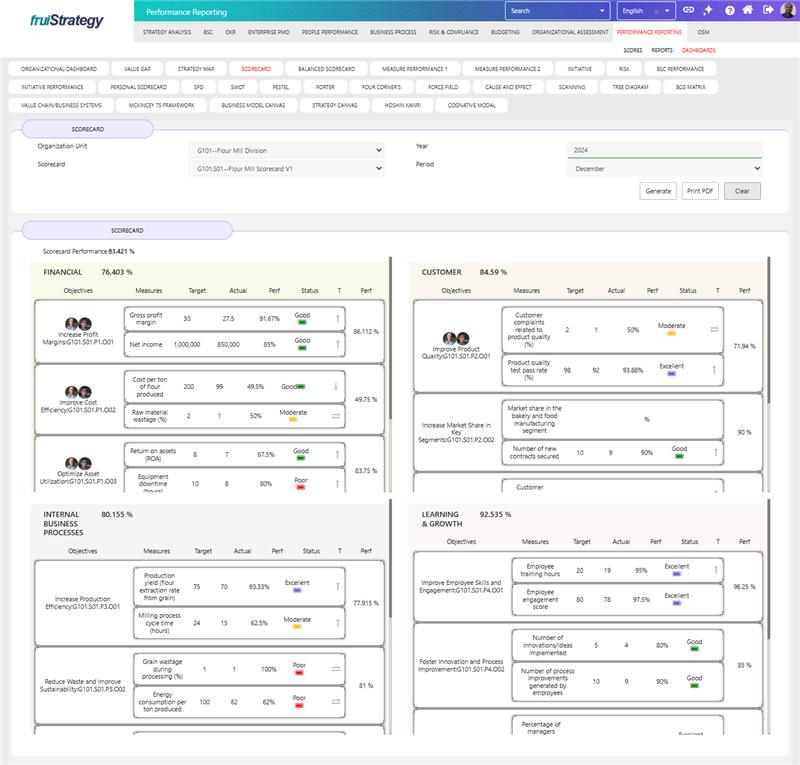
By linking strategy with execution, fruiStrategy helps FMCG businesses boost innovation, market relevance and operational efficiency.